Assessment
CEUs: 1.54
Course ID: ACSI20260008
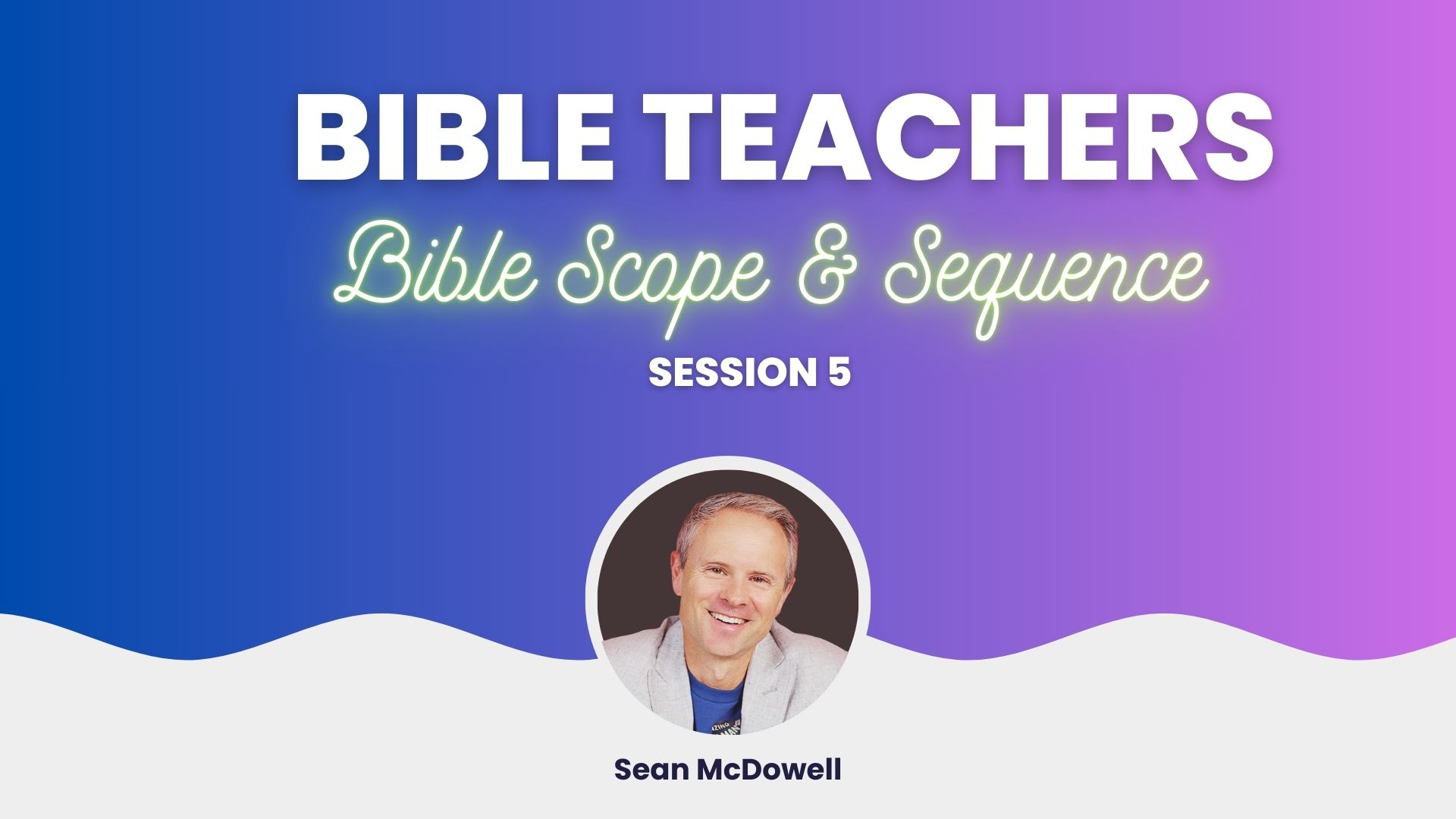
We all want our students to read and understand the Bible, and yet we may lack a practical plan for doing so. In this session of the 2026–27 Bible Teacher Network webinar series, Dr. Sean McDowell provides a practical strategy for a 1–2 week study on a New Testament book, specifically for grades 11–12, but could be adapted for grades 9–10. This course equips Bible teachers to lead students in studying Scripture through an inductive approach that builds independence and critical thinking. Rather than focusing on delivering content, teachers will learn how to guide students in observing, interpreting, and synthesizing the text for themselves. Participants will explore practical strategies for structuring classroom experiences that help students think theologically and philosophically. By the end of the course, teachers will be prepared to create meaningful, student-centered Bible study experiences that increase engagement and confidence.
Course ID: ACSI202651173
This course equips school leaders with practical, immediately implementable tools to bring their school's mission to life through deeper spiritual formation and theological engagement. Guided by Samantha Farinacci, who oversees Spiritual Life, Student Life, and theological engagement at Oaks Christian Online, you’ll discover practical, fresh ways to strengthen your school’s identity and culture. Designed for heads of school, directors, chaplains, and mission-focused leaders, this course will spark meaningful conversations and actionable next steps for your school community. This course is 1.50 Bible CEUs.
Course ID: ACSI20260007
This California-mandated anti-harassment training is led by Philip Scott, Vice President for Legal Affairs, and Jennifer Gonzales, ACSI Senior Human Resource Generalist, of ACSI. Designed for employees in Christian schools, this course explains California and federal harassment laws, reporting responsibilities, and workplace bullying prevention while providing practical guidance for maintaining a respectful, legally compliant, and Christ-centered work environment.
Course ID: ACSI20260002
This California-mandated anti-harassment training is led by Philip Scott, Vice President for Legal Affairs, and Jennifer Gonzales, ACSI Senior Human Resource Generalist, of ACSI. Designed for supervisors in Christian schools, this course explains California and federal harassment laws, reporting responsibilities, and workplace bullying prevention while providing practical guidance for maintaining a respectful, legally compliant, and Christ-centered work environment.
Course ID: ACSI20260001

In this new and revised Christian Philosophy of Education series (2026), multimedia segments present a foundation of teaching from an intentionally Christian perspective. Course 2 Foundations, the second of three courses in this series, clarifies the roles of the home, church, and school in the education of children, examines how Scripture defines the learner and teacher, and explores the purpose of curriculum and its impact on the aims of education. This three-course series fulfills ACSI's Christian Philosophy of Education requirement.
Download Course 2 Syllabus – "Foundations"This course is worth 6 Educational CEUs.
In this new and revised Christian Philosophy of Education series (2026), multimedia segments present a foundation of teaching from an intentionally Christian perspective. Course 3, Biblical Integration, provides a framework for practical analysis and application of integrating biblical truth into the overall curriculum and daily instruction. Courses 1 and 2 are prerequisites to this course for those pursuing the ACSI Philosophy of Christian Education Requirement.
Download Course 3 Syllabus – "Biblical Integration"This course is worth 6 Educational CEUs.
This course equips Christian educators to navigate AI tools with wisdom, discernment, and practical skill. Participants explore ethical guidelines, compare major AI platforms, and practice effective prompting to support teaching and learning. Through hands-on demonstrations with tools such as ChatGPT, Gemini, Canva, and NotebookLM, educators learn to design assignments, maintain academic integrity, and integrate AI within school systems while upholding biblical values and student privacy. This course was curated from a webinar in 2025.
Course ID: ACSI20250017
In this new and revised Christian Philosophy of Education series (2026), multimedia segments present a foundation of teaching from an intentionally Christian perspective. Course 1 Worldview, the first of three courses in this series, defines and explores worldviews, explains a biblical worldview, and describes a philosophy of education from a biblical perspective. This three-course series fulfills ACSI's Christian Philosophy of Education requirement.
Download Course 1 Syllabus – "Worldview"This course is worth 6 Bible CEUs.

This course equips Christian educators to navigate artificial intelligence with biblical wisdom and practical discernment. Through a Christian framework and real-world examples, participants will learn how AI works, how to evaluate tools responsibly, and how to guide students, teachers, and school communities with clarity. Designed for teachers, technology leaders, and administrators seeking confidence and direction in a rapidly changing educational landscape.
Course ID: ACSI20250016
Iowa Assessments: Criterion-Referenced Insights in Science
This course equips educators with the knowledge and skills to effectively interpret Iowa Assessments science results using a criterion-referenced approach. Participants will learn how science assessment items align with learning standards, examine cognitive demand levels and item-level data, and use a variety of assessment reports to identify student strengths and areas for growth. Through practical examples and expert guidance, the course demonstrates how to transform assessment data into meaningful instructional decisions that support targeted interventions, curriculum refinement, and improved student achievement in science.
Course ID: ACSI2025SAP07
Iowa Assessments: Norm-Referenced Insights in Reading & Math
This course was curated from ACSI’s Iowa Authors' Series: Using the Iowa Assessments to Support Norm-referenced Interpretations in Reading and Math. This course will teach educators how to interpret Iowa Assessments data using locally defined benchmarks and meaningful performance thresholds. Guided by Drs. Stephen Dunbar and Catherine Welch’s insights, this course helps teachers to focus on domain- and group-level patterns rather than isolated test items. Learners will identify trends, spot instructional strengths and gaps, and translate data into actionable next steps. By the end, learners will confidently support collaborative, accurate, and instructionally useful data conversations.
Course ID: ACSI2025SAP04
Iowa Assessments: Supporting Criterion-Referenced Interpretations in Math
This course was curated from ACSI’s Iowa Assessments program webinar in 2025, Iowa Authors' Series: Using the Iowa Assessments to Support Criterion-Referenced Interpretations in Math. This course explores the Iowa Assessments in mathematics, emphasizing criterion-referenced interpretations. Learners will analyze student performance using item-level metrics, standard scores, and classroom reports, connecting assessment data to instructional goals. The course equips educators to interpret results, track growth, and align teaching with standards for improved student outcomes.
Course ID: ACSI2025SAP04
Iowa Assessments: Norm-Referenced Insights in Science & Social Studies
This course was curated from ACSI’s Iowa Authors' Series: Using the Iowa Assessments to Support Norm-referenced Interpretations in Science and Social Studies. This course equips educators to interpret Iowa Assessment results in science and social studies using current national norms. Participants learn to analyze national percentile ranks, growth trends, cohort patterns, and benchmark thresholds to identify student needs and instructional priorities. Through exploration of updated 2024 normative data, educators gain practical tools for understanding performance shifts, evaluating local trends, and making data-informed decisions that support student growth.
Course ID: ACSI2025SAP05
Iowa Assessments: Reading Insights
This course was curated from ACSI’s Iowa Assessments program webinar in 2025, Iowa Authors' Series: Using the Iowa Assessments to Support Criterion-referenced Interpretations in Reading. Develop practical skills for interpreting assessment data to guide instruction and support student growth. Emphasis is placed on using multiple measures—reading, vocabulary, and writing—to identify learning needs and strengthen literacy instruction. Through real examples given by test authors, Drs. Stephen Dunbar and Catherine Welch, learners analyze reports, uncover learning patterns, and apply data insights to classroom practice. The course equips educators to use assessments as tools for improving instruction and fostering early literacy success.
Course ID: ACSI2025SAP03

CogAT: Leverage Student Ability for Strength-Based Differentiation and Learning
Explore the CogAT assessment to uncover not only what students know, but how they learn. This course equips educators to interpret ability profiles across verbal, quantitative, and nonverbal reasoning, applying strategies to strengthen weaknesses and extend strengths. Learning about these differences glorifies God by recognizing how each student is uniquely created in His image. Participants will gain practical tools to design instruction that promotes growth, engagement, and confidence while honoring each child’s God-given abilities.
Course ID: ACSI2025SAP02

CogAT: Unlock Student Potential and Ability for Achievement and Growth
This course provides an in-depth exploration of the Cognitive Abilities Test (CogAT) and its application in educational settings. Participants will learn how CogAT measures verbal, quantitative, and nonverbal reasoning, interpret composite and pattern scores, and compare ability with achievement data. The course, designed for teachers and school leaders at all levels, emphasizes using assessment results to inform differentiated instruction, identify student strengths and opportunities, and support equitable talent development across diverse classroom populations.
Course ID: ACSI2025SAP01
Iowa Assessments: Supporting Criterion-Referenced Interpretations in Reading
| Every student has a unique story and a unique trajectory along the learning continuum. Educators seek a combination of proven and creative solutions to assess student achievement and prepare for the next steps. The Iowa Assessments metrics clearly and concisely represent where a student is at a given point in time and help to establish goals for future points in time. This series will address specific metrics and how they can be used to support varied interpretations. Measuring student performance and growth are valid uses of the Iowa Assessments. The standard score directly addresses the challenges of measuring growth while providing stable estimates for goal setting. The Iowa Assessments also provide item-level metrics that help educators gain a better understanding of how students are performing on specific items associated with specific standards. This course will identify and discuss these metrics that best support the use of criterion-referenced interpretations in reading. |
Iowa Assessments: Supporting Criterion-Referenced Interpretations in Math
| Every student has a unique story and a unique trajectory along the learning continuum. Educators seek a combination of proven and creative solutions to assess student achievement and prepare for the next steps. The Iowa Assessments metrics clearly and concisely represent where a student is at a given point in time and help to establish goals for future points in time. This series will address specific metrics and how they can be used to support varied interpretations. Measuring student performance and growth are valid uses of the Iowa Assessments. The standard score directly addresses the challenges of measuring growth while providing stable estimates for goal setting. The Iowa Assessments also provide item-level metrics that help educators gain a better understanding of how students are performing on specific items associated with specific standards. This course will identify and discuss these metrics that best support the use of criterion-referenced interpretations in mathematics. |
Iowa Assessments: Supporting Norm-Referenced Interpretations in Math and Reading
Every student has a unique story and a unique trajectory along the learning continuum. Educators seek a combination of proven and creative solutions to assess student achievement and prepare for the next steps. The Iowa Assessments metrics clearly and concisely represent where a student is at a given point in time and help to establish goals for future points in time. This series will address specific metrics and how they can be used to support varied interpretations.
Comparison information is a key attribute of the Iowa Assessments. National percentile ranks allow educators to make appropriate comparisons at the region, school, and class levels. This course will identify and discuss the metrics that best support the use of norm-referenced interpretations in both mathematics and reading. The emphasis is on maximizing the usefulness of the information.